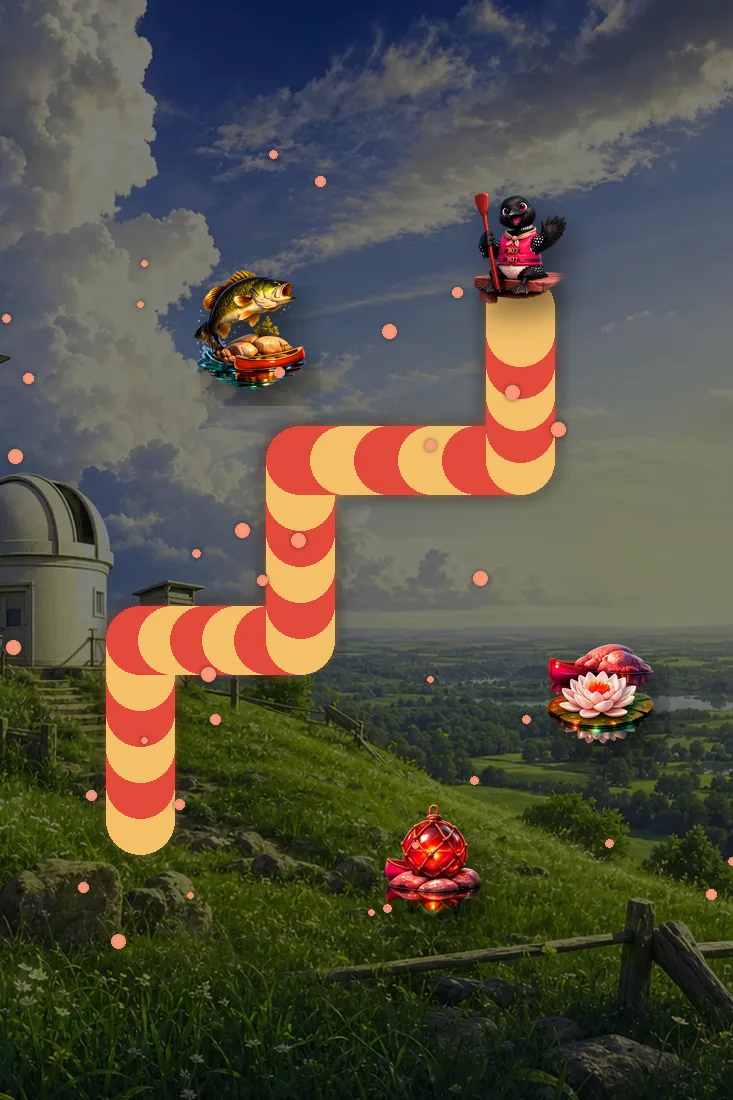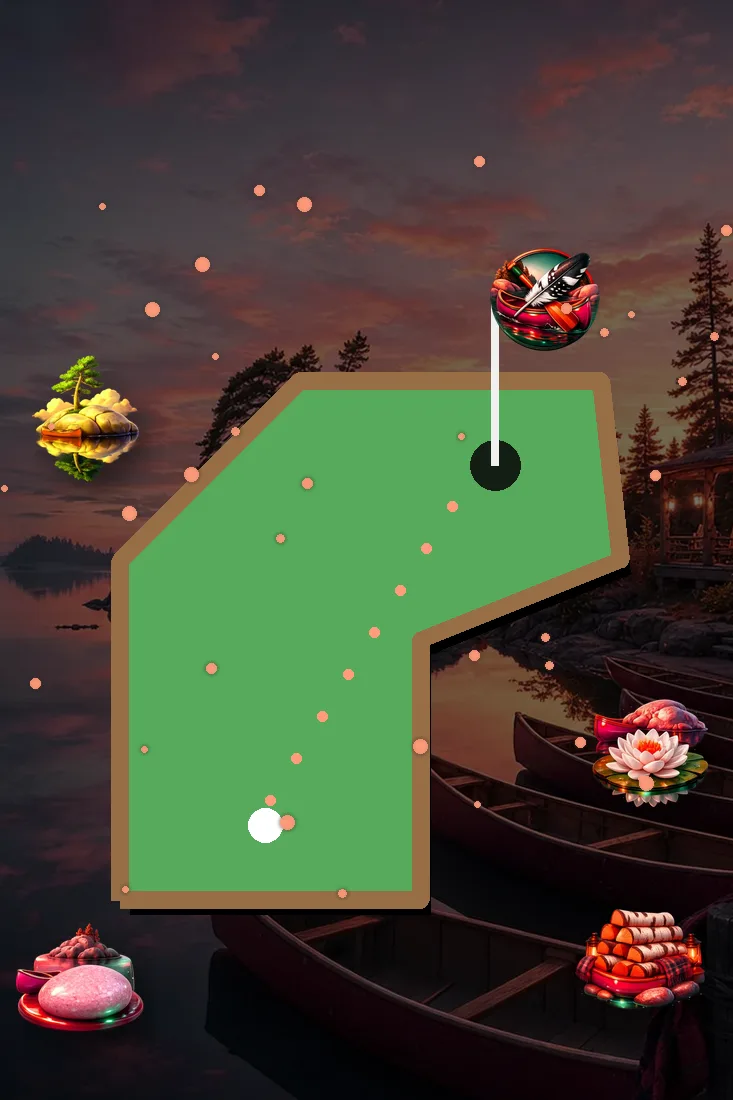
Portage Putt is the game we hand to every new guest. The course runs along the shore in nine holes, each named for a place you might paddle past on a lake-country weekend: the dock ramp, a cedar narrows, a beaver dam dogleg, a sunset bay. Pines, lilies, birch logs and pink granite pebbles sit around the edges as scenery, while the ball, the walls and the cup are what matter.
Putting is a single, satisfying gesture. Press on the ball, drag back the way a slingshot works, and a dotted guide shows where it will travel. The further you pull, the harder it goes. Let go and the ball rolls with realistic friction and bounce. Every hole has a par, and the scorecard fills as you go, so a whole round becomes a small story of good reads and near misses.
How to play Portage Putt
- Press start on the course card, then look over the first hole to find the cup and anything in the way.
- Press on the ball and drag back, away from where you want it to go, until the dotted guide points true.
- Pull further for a stronger putt or shorter for a gentle tap, then release to send the ball rolling.
- Watch for sand that slows the ball, slopes that bend it, gates that slide and water that sends it back.
- Sink the ball, check your strokes against par on the scorecard, and carry on to the next of nine holes.
Portage Putt controls
Getting better at Portage Putt
- Take a moment before each putt to trace the route, including any wall you plan to bank off.
- A softer putt that stops near the cup beats a hard one that rattles around the hole and drifts off.
- Banks are reliable: the ball leaves a wall at a believable angle, so use them like a pool player.
- With a moving gate, watch it make one full trip first, then putt to arrive as it opens.
- Treat par as a guide rather than a demand. A calm bogey is better than a rushed attempt at a hero shot.
Why a pull-back putt feels so right on a phone
We tried tap-to-aim and a power meter that swung back and forth, and both felt like operating a machine. Pulling back from the ball felt like playing. Your finger or mouse becomes the club, the dotted guide is your eye along the shaft, and the length of the drag is the strength of your swing. It took only a few seconds for every tester to understand it, including the youngest.
The physics underneath is what makes it honest. The ball loses speed steadily on the green, faster in sand, and rebounds from walls and bumpers in a way you can learn. Once you trust the surface, you start planning two-cushion banks and soft lag putts that curl up beside the cup. That trust is the whole game, and we spent more time tuning friction than drawing anything else.
How nine holes are laid out along the bay
Each hole is built from a library of templates we designed by hand: straight runs with a guarding wall, doglegs, bumper gardens, sand traps, water hazards, gentle slopes and gates that slide across a gap. The course for Loonlightlodge is assembled from these in a fixed order for the lodge, so the hole you learned on Tuesday is the same hole on Friday.
Every template is checked so the cup can always be reached. Water never swallows the only route, gates always open long enough to pass, and slopes bend a putt without making it a lottery. Par reflects what a thoughtful round should take, and the scorecard shows you strokes beside it for each hole. Beating par on the beaver dam dogleg is a small thrill we still enjoy.
Questions about Portage Putt
The ball comes back so you can putt again, and the stroke still counts on your scorecard. It is a nudge to read the hole more carefully, never the end of your round.
Yes. The nine holes for Loonlightlodge are fixed, so you can learn each one, plan better routes and try to lower your total against par from one evening to the next.
No. A trackpad or a finger on a touch screen works just as nicely, because the whole putt is one press, one pull back and one release.