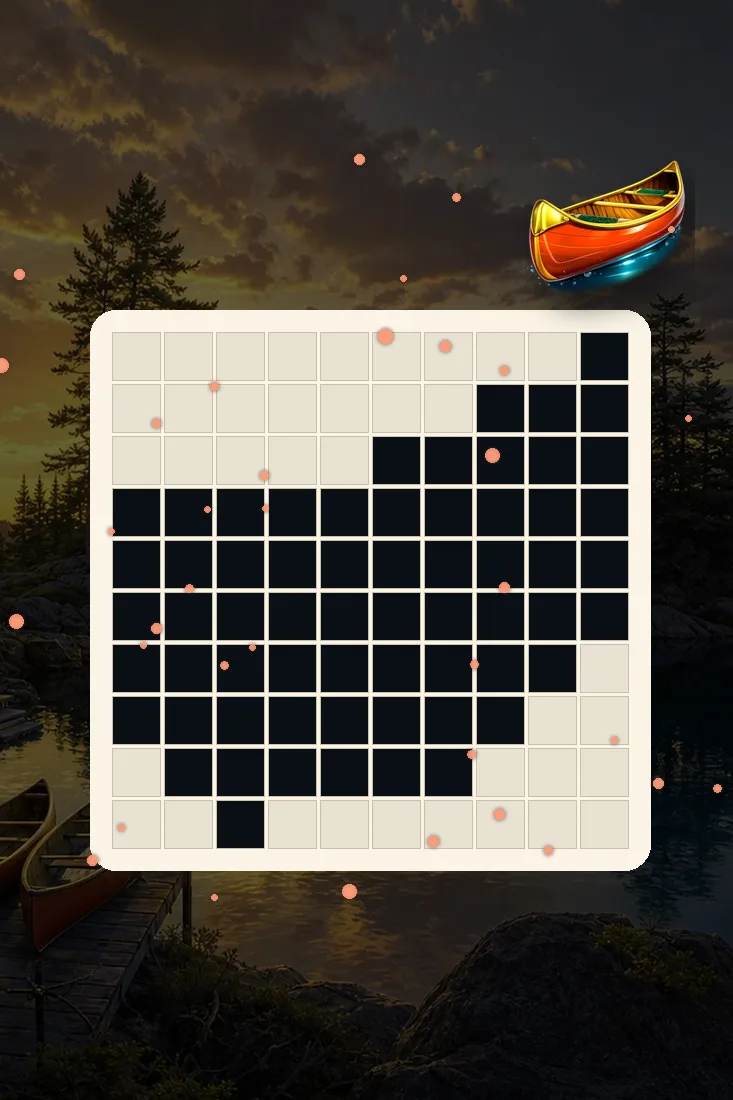
Birchbark Grids is the game that makes our studio go quiet. Each puzzle starts as an empty grid with short runs of numbers beside every row and above every column. A clue of 3 1 means a block of three filled cells, then at least one gap, then a single filled cell. Put all the clues together correctly and a picture emerges: a canoe, a toque, a rocking chair, a leaping bass.
There are twelve pictures, all drawn from the same objects you see around the lodge, and each is built directly from the shape of its icon. Grids come in 10x10 for a steady half hour and 15x15 for a long, absorbing session. When the last correct cell goes in, the black-and-white answer gives way to the full-colour icon, which never gets old.
How to play Birchbark Grids
- Pick one of the twelve pictures and a grid size, 10x10 for a gentler start or 15x15 for a longer think.
- Read the numbers beside a row: each number is a run of filled cells, in order, with gaps between runs.
- Fill cells you can prove must be filled, starting with rows whose clues nearly span the whole width.
- Switch to cross mode to mark cells you know are empty, which narrows down every neighbouring line.
- Keep trading between rows and columns until every clue is satisfied and the colour picture appears.
Birchbark Grids controls
Getting better at Birchbark Grids
- Start with big clues. In a 10x10 row, a clue of 8 tells you the middle six cells are filled for certain.
- A row with a clue of 0 is empty from end to end, so cross it all out straight away and move on.
- Crosses are as valuable as fills. Marking empty cells is often what unlocks the next column.
- Watch the clue highlighting; it shows which line you are working on so your eyes do not wander.
- On a 15x15 grid, take a break when you stall. Fresh eyes usually spot the deduction you missed.
Pictures pulled straight from the lodge shelf
We did not draw the puzzles cell by cell. Each one is made from an icon you already know from the lodge: the game looks at the outline of the cedar canoe, the steaming cocoa or the pine on its granite islet, reduces it to a grid, and turns the filled shape into clues. We chose the twelve with the clearest silhouettes, so the finished pattern really does look like the object.
That means every solve has a small reveal built in. Partway through a grid you start to guess what is coming, maybe the curve of a paddle blade or the arms of a rocking chair. The last few cells confirm it, and then the plain grid lifts to show the icon in full colour. Some guests collect all twelve in 10x10 before trying any at the larger size.
Thinking in lines, the nonogram habit
The trick to these puzzles is that you never need to guess. Every cell can be proven by looking at its row and column together. If a clue of 7 must fit in a row of ten, the run cannot avoid the middle four cells, however it slides. Fill those, then look at the columns they touch. Each small certainty spills into the next line.
Cross mode exists for exactly this reason. Marking a cell as definitely empty is a deduction too, and it often decides whether a short run sits on the left or the right. The grid lets you drag to paint several cells in one stroke, which keeps the bookkeeping quick. Solving well feels less like searching and more like following a trail of footprints across fresh snow.
Questions about Birchbark Grids
Each number is a run of filled cells in that row or column, listed in order. Between runs there is always at least one empty cell, so 2 3 means two filled, a gap, then three filled.
Start with 10x10. The logic is the same at both sizes, but 15x15 has many more interlocking lines, so it rewards a little practice and a long, quiet evening.
We check each picture so its grid is a fair puzzle, and we skip shapes that would leave rows mostly empty. With patient line-by-line reasoning you can always make progress.